
How to Use The Genius Wave (Timing & Routine)
Last updated: June 23, 2026
Here’s a practical, step-by-step guide on how to use The Genius Wave so you can judge it fairly in everyday life. The goal is not theory; it’s a routine you can repeat in about ten minutes that reliably moves you from scattered to centered—then straight into meaningful action. Nothing here is medical advice; always verify the current instructions and refund terms on the official site.
The 10-minute ritual (the simple version)
- Pick a fixed slot that you can protect—most people choose mornings, but lunch or early evening also works. Consistency beats perfection.
- Set the scene: phone on Do Not Disturb, chair with back support, feet grounded, relaxed shoulders. Volume at a comfortable, moderate level.
- Press play and breathe: inhale through the nose, exhale slightly longer than the inhale. Let the audio carry your attention.
- One-goal rule: as soon as the track ends, start the one high-leverage task you chose yesterday. No inbox. No feeds.
- Micro-log (2 minutes): record focus (0–10), minutes from audio end to action, and whether you completed the one task before lunch.
Morning vs. afternoon (choose your lane)
Morning is the default because it shapes the day’s arc and prevents decision drift. If mornings are hectic, choose a pre-work or pre-study slot that you can treat as sacred. Afternoon use works well when paired with a light lunch and a screen break to avoid sleepiness. What matters most is a stable window—keep your session within the same 30-minute band daily.
Headphones vs. speakers
- Headphones help in noisy spaces and reinforce the “ritual boundary.” Avoid excessive volume and don’t use while driving.
- Speakers are fine in quiet rooms; ensure others won’t interrupt. Place the speaker shoulder-level or higher for an even field.
- Comfort first: choose the option you can repeat daily without fuss.
Environment cues (make it automatic)
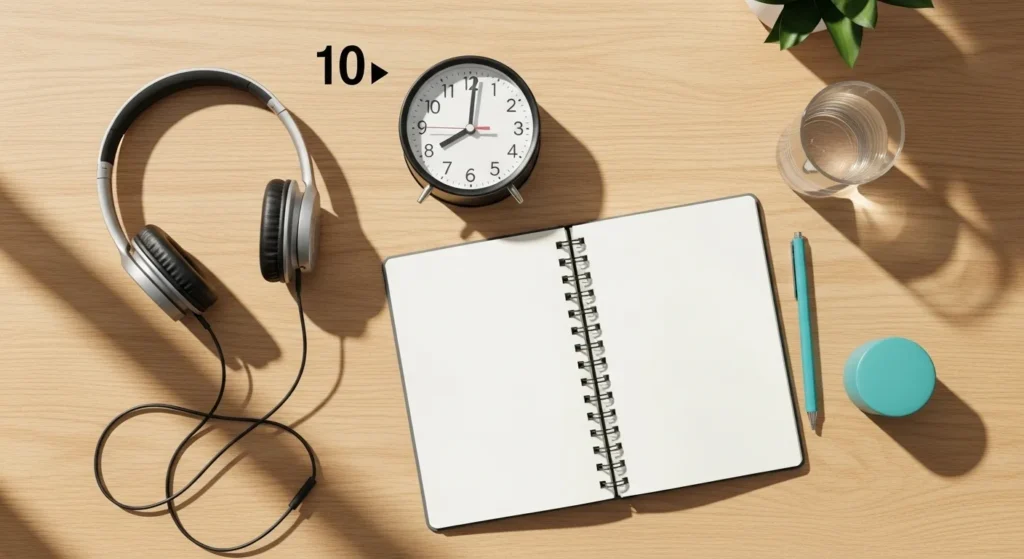
- Visual cue: keep headphones beside a water glass and a blank notepad; that cluster becomes your start signal.
- Digital cue: recurring calendar alert with “Listen → One Goal” in the title. Snoozes allowed once, not twice.
- Physical cue: pre-open the document, canvas, or code repo you’ll work on immediately after listening.
The 6-week plan (so your results are visible)
- Week 1 — Setup: lock your slot, install cues, define tomorrow’s one task each evening, and start the micro-log.
- Week 2 — Rhythm: keep the slot inside the same 30-minute window; add a 60–120 second movement primer before listening.
- Week 3 — Signal: expect faster startup and longer focus blocks. Keep Do Not Disturb on for 30–60 minutes post-session.
- Week 4 — Compounding: tweak only one variable—meal timing, movement primer, or the exact listening chair—not all three.
- Week 5 — Confidence: scale the one-goal rule to a second block in the afternoon if useful.
- Week 6 — Decision: review your log; compare to baseline; keep or drop based on data, not anecdotes.
Special scenarios
- Students: use it before reading-heavy sessions; keep the phone out of reach until you complete one study block.
- Creators: pair it with a non-negotiable “first draft” window; quantity before quality.
- Managers: listen before a 90-minute planning block; write the day’s three priorities immediately after.
- Parents: a shorter “reset” later in the day (if provided) can help transition between roles.
- Sleep: if a pre-sleep variant exists, keep volume low, lights dim, and screens off for 30–60 minutes afterward.
Troubleshooting (common sticking points)
- Can’t get comfortable: switch chair posture, lower the volume, or try speakers if headphones feel claustrophobic.
- Mind keeps racing: use a slow body scan; label thoughts briefly (“planning,” “worry,” “noise”) and return to sound.
- Sleepy during session: sit upright, cool the room slightly, and add a one-minute breath or mobility primer.
- No action afterward: enforce the one-goal rule; place the exact work artifact (doc, canvas) front and center before you press play.
- Inconsistent timing: treat your slot like a meeting with your future self. If you miss, do it later the same day rather than skipping.
Minimal daily log (2 minutes)
- Focus (0–10) at the same time each day.
- Startup time from audio end to first meaningful action.
- AM/PM “one thing” completed? (yes/no)
- Mood steadiness (0–10) if you want a fourth metric.
Related: Full Review · Benefits & Results · FAQ · Side Effects & Safety · Inside the Program & Science · Price & Guarantee
Leave a Reply
Related Posts